 中文


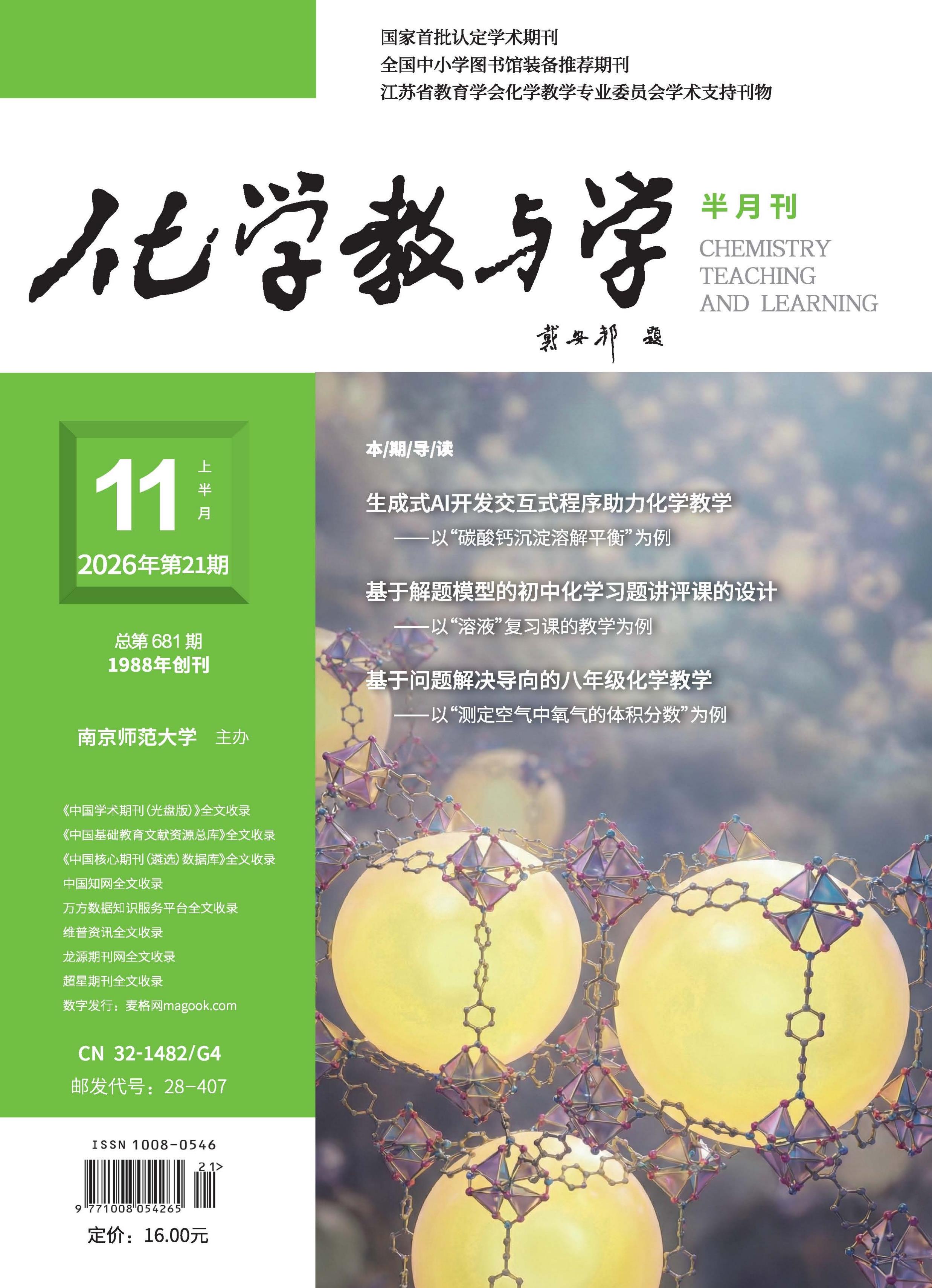
Chemistry Teaching and Learning

- :Jiangsu Education Department
- :Nanjing Normal University
- :1998
- :Semimonthly
- ISSN: 1008-0546
- :CN 32-1482/G4
- :28-407
- :
- :
该翻译结果由
 提供平台支持,由DeepSeek 模型实际翻译
Issue 21 , 2026
Developing Interactive Programs with Generative AI to Assist Chemistry Teaching: A Case Study of “Calcium Carbonate Precipitation–Dissolution Equilibrium”
Shi Haihua[1]
(3-6)


A Preliminary Exploration of the Development of Interactive Web Courseware for High School Chemistry Based on Generative Artificial Intelligence: A Case Study of “Visualization of the Structures and Reactions of Organic Compounds”
Zhao Haoyue[1,2];Cao Rui[3]
(11-17)
Practical Exploration of AI-Empowered National Security Education in High School Chemistry: A Case Study of Project-Based Learning on "Carbon Neutrality"
Li Hongming[1]
(18-22)
Application of Digital Technology in Junior High School Chemistry Teaching: Taking the Teaching of "General Ideas and Methods for Preparing Gases in the Laboratory" as an Example
Jiao Ming[1]
(23-25)
Driving Instruction for Constructing the Particle View through a “Context–Question–Evidence” Chain: A Case Study of “Molecules and Atoms” (Period 1)
Sheng Yuyan[1];Xu Yunyun[2];Yang Xiaohua[3]
(26-31)
Practical Exploration of Fourfold Representation Teaching of Neutralization Reactions from the Perspective of Learning Progression
Chi Hongsheng[1]
(32-37)
An Analysis of the Teaching Pathway for the Big Idea of “View of Material Transformation” in Junior High School Chemistry: A Case Study of the Interdisciplinary Project “Preparation of Calcium Sulfite”
Shao Hengyang[1]
(38-41)
Project-Based Learning in Junior Secondary School Chemistry Based on Cultural Relic Restoration: A Case Study of the Protection of the Grey-Brick City Wall of Dapeng Fortress
Zhao Shuangyan[1];Yuan Shunxiang[2]
(42-46)
An Interdisciplinary Practice in Junior High School Chemistry Based on the Principle of Slow Oxidation: A Case Study of “Pigment Extraction and Printing/Dyeing from Kitchen Waste”
Jiang Zhuo[1];Cui Malin[1];Tan Hongyu[1];Huang Miaoling[1];Xu Hezan[2];Chen Nengxiang[3]
(51-56)
A Practical Study on Using Project-Based Learning to Break Through Pain Points in Chemistry Teaching: A Case Study of “Exploring Hydrogen-Powered Vehicles”
Li Huayi[1]
(57-61)
Design of Junior High School Chemistry Exercise Review Lessons Based on a Problem-Solving Model: Taking the Teaching of a “Solutions” Review Lesson as an Example
Wu Pinqing[1];Zhuang Shan[1]
(62-67)
Junior High School Chemistry Review Teaching Oriented Toward Core Competencies in Real-World Problem Contexts: A Case Study of the Review Lesson on “Chemical Fertilizers”
Cai Shifeng[1]
(72-75)
Designing Interdisciplinary Unit Practice-Oriented Assignments for Junior High School Chemistry: A Case Study of “The Evolution and Rational Use of Household Fuels”
Ma Zhihui[1]
(76-80)
The Practice of Integrating Teaching, Learning, and Assessment in Senior Three Industrial Process Teaching
Zhu Jiqin[1]
(81-85)
Problem-Solving-Oriented Eighth-Grade Chemistry Teaching: A Case Study of “Determining the Volume Fraction of Oxygen in Air”
Zhang Min[1]
(86-88)
Innovative Improvements and Teaching Practices in Molecular Motion Experiments
Mo Chongjiao[1];Wei Minggui[2];Chen Yan[3]
(89-91)
Innovative Design of Experiments on the Substitution and Elimination Reactions of Bromoethane
Tan Ying[1];Wang Binxiang[1];Zhang Lin[2];Zhou Yang[1];Yang Liu[3]
(92-96)